
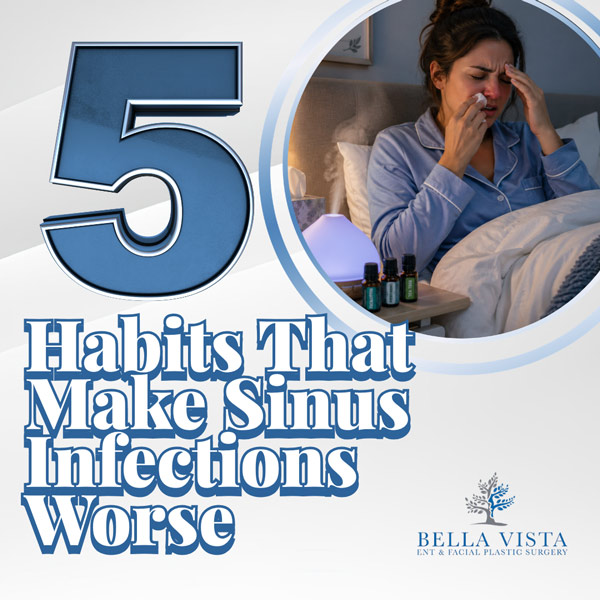
5 Habits That Make Sinus Infections Worse
Thousand Oaks has a reputation for clean air, open space, and the kind of outdoor lifestyle that makes Ventura County one of the most desirable places to live in Southern California. But that reputation can be quietly misleading when it comes to sinus health. The Santa Ana winds that funnel through the region every fall carry dust, mold spores, and fine particulates that hit the nasal passages hard. Wildfire smoke from across the county pushes airborne irritants into every home. Spring in the Conejo Valley brings a dense wave of oak, olive, and grass pollen that keeps allergists busy for months. Living well here doesn’t automatically mean your sinuses are doing the same. At Bella Vista ENT, we regularly work with patients whose sinus infections keep returning — and in many cases, specific daily habits are quietly extending the problem. Here are five worth examining closely.
1. Assuming Natural Remedies Are Enough to Clear an Infection
Southern California has a strong wellness culture, and Thousand Oaks is no exception. Essential oil diffusers, herbal teas, steam tents, and supplement regimens are all popular approaches to managing sinus symptoms at home — and some of them offer genuine comfort during a sinus infection. The problem arises when they become the primary strategy rather than a supplement to proper care.
Essential oils can actually irritate already inflamed nasal membranes in some individuals, particularly eucalyptus and peppermint in high concentrations. DIY steam inhalation without proper temperature control risks thermal irritation of sensitive nasal tissue. And while these approaches may soften symptoms temporarily, none of them address the bacterial load, structural blockages, or underlying allergic inflammation that drive infections in the first place. Comfort and treatment are different things — and confusing the two delays the care that actually resolves the infection.
2. Dismissing Postnasal Drip as a Minor Nuisance
Postnasal drip — that persistent sensation of mucus trickling down the back of the throat — is one of the most commonly overlooked signals in sinus health. Most people treat it as a minor inconvenience, reaching for a throat lozenge or a glass of water and moving on. But chronic postnasal drip is your body telling you that your sinuses are overproducing mucus in response to ongoing inflammation, infection, or an allergen trigger that hasn’t been identified.
Left unaddressed, postnasal drip contributes to chronic throat irritation, persistent cough, disrupted sleep, and a low-grade feeling of being unwell that’s easy to normalize over time. It also means infected or allergen-laden mucus is continuously moving through your airway, keeping your immune system in a reactive state. If postnasal drip has become a background feature of your daily life, it deserves more than tolerance — it deserves evaluation.
3. Not Accounting for Wildfire Smoke Season
For Ventura County residents, wildfire smoke is no longer a rare event — it’s a seasonal reality. And while most people understand that smoke is unpleasant, fewer recognize the specific damage it does to sinus tissue. Wildfire smoke contains ultra-fine particulate matter that penetrates deep into the nasal lining, triggering inflammatory responses that can persist long after the smoke has cleared. For someone already dealing with a sinus infection, smoke exposure is like throwing fuel on a fire that was already burning.
The habit that makes this worse is treating smoke days the same as any other day — going about normal outdoor routines, running with windows open, and failing to protect indoor air quality during active smoke events. On heavy smoke days, keeping windows closed, running an air purifier with a HEPA filter, and limiting outdoor exposure are not optional precautions for sinus patients — they’re essential ones.
4. Poor Posture During Long Screen Hours
This one rarely appears on sinus health lists, but it should. Thousand Oaks has a significant population of remote workers and professionals who spend long hours at desks and screens. Poor posture may contribute to neck tension, facial pressure, or a sensation of congestion, which may feel like a worsening infection in some individuals, but is being mechanically reinforced by how you’re sitting.
Taking regular movement breaks, adjusting screen height so your gaze is roughly level, and incorporating gentle neck stretches throughout the day can meaningfully reduce that mechanical congestion alongside whatever medical treatment you’re receiving.
5. Not Asking the Right Questions Before Choosing a Specialist
When sinus infections become recurring, the decision to see a specialist is the right one — but there is plenty to consider before booking an appointment with an ENT. Not all clinics approach sinus care with the same depth. Modern ENT clinics focused on sinus and allergy conditions may offer in-office nasal endoscopy, CT sinus imaging, and comprehensive allergy testing. Choosing the right ENT means finding a specialist whose focus aligns with your specific condition — someone who can evaluate underlying contributors to recurring sinus symptoms.
Thousand Oaks Deserves Better Than Recurring Infections
Good habits create the conditions for recovery, but they can only take you so far when something deeper is driving the cycle. At Bella Vista ENT, we take the time to understand what’s actually behind your sinus problems — not just what’s happening this week.
Let’s get to the bottom of what’s keeping your sinuses from healing. Schedule your appointment with Bella Vista ENT today!
One of the most frustrating things about sinus problems is the feeling that you’ve finally moved past them—only to have the symptoms return a few…

If you live in Thousand Oaks, you may notice your sinuses act up when the weather changes. Bella Vista ENT often sees patients who feel fine one…