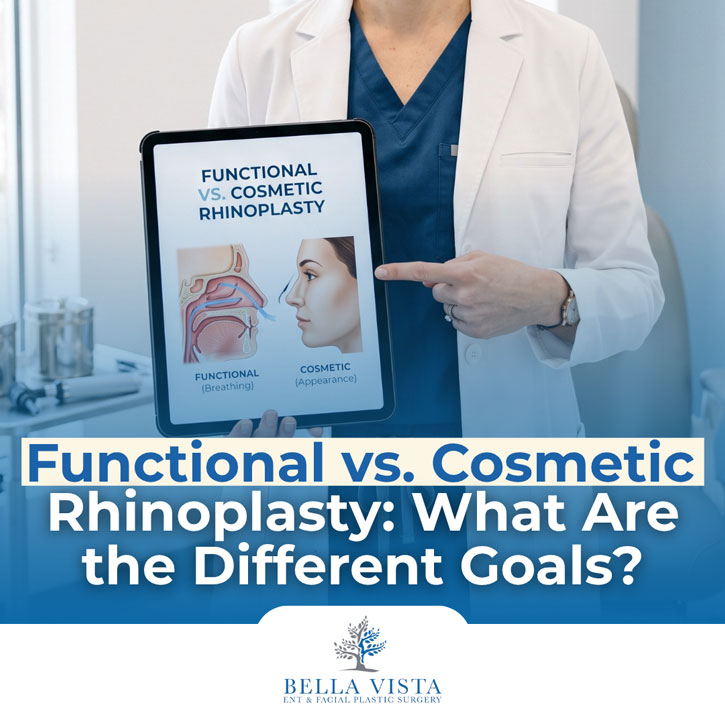
Functional vs. Cosmetic Rhinoplasty: What Are the Different Goals?
Rhinoplasty, sometimes called a nose job, is not always performed for the same reason. Some patients pursue surgery because they want to change the appearance of their nose. Others need surgery to address structural problems that restrict airflow and make nasal breathing difficult.
These approaches are commonly described as functional and cosmetic rhinoplasty. Although their primary goals differ, they can sometimes be combined because changing the nose’s structure may affect both breathing and appearance.
At Bella Vista ENT, patients can be evaluated for functional and cosmetic nasal concerns and learn which surgical approach may be appropriate for their anatomy and goals.
What Is the Difference Between Functional and Cosmetic Rhinoplasty?
Functional rhinoplasty is performed primarily to improve nasal airflow by correcting structural problems that interfere with breathing. Cosmetic rhinoplasty is performed primarily to change the nose’s appearance, proportions, or relationship to other facial features.
Some patients have both functional and cosmetic concerns. In those cases, a combined procedure may address breathing and appearance during the same operation when clinically appropriate.
What Is Functional Rhinoplasty?
Functional rhinoplasty is reconstructive nasal surgery intended to improve breathing and nasal function. It generally focuses on structural parts of the nose that help keep the nasal airway open.
One common concern is nasal valve narrowing or collapse. The nasal valve is the narrowest part of the nasal airway. If it is weak, narrow, or damaged, the sidewall of the nose may pull inward during inhalation and restrict airflow.
Functional rhinoplasty may reshape or reinforce cartilage and other supporting structures to improve the stability of the nasal airway.
What Problems May Functional Rhinoplasty Address?
Depending on the patient’s anatomy, functional rhinoplasty may be considered for:
- Nasal valve collapse.
- Narrowing of the internal or external nasal valve.
- A crooked or twisted nasal framework that obstructs airflow.
- Structural changes caused by a previous injury.
- Congenital nasal differences.
- Breathing problems following previous nasal surgery.
- Weakness or loss of cartilage supporting the nasal airway.
Not every breathing problem requires functional rhinoplasty. Allergies, chronic inflammation, nasal polyps, enlarged turbinates, and sinus disease may require different treatments.
Is Functional Rhinoplasty the Same as Septoplasty?
No. Functional rhinoplasty and septoplasty are related procedures, but they are not interchangeable.
A deviated septum occurs when the wall dividing the nasal passages is significantly off-center. Septoplasty is the procedure used to straighten or reposition the septum.
Functional rhinoplasty typically addresses the outer nasal framework, nasal valves, or other structural areas beyond the septum. Some patients have obstruction involving both the septum and the nasal valves. In those cases, septoplasty and functional rhinoplasty may be performed together.
Turbinate reduction may also be included when enlarged turbinates contribute to obstruction. The appropriate combination depends on the examination findings.
What Is the Primary Goal of Functional Rhinoplasty?
The primary goal is to improve nasal airflow and function. Potential objectives may include:
- Creating more space for air to pass through the nose.
- Supporting a weak or collapsing nasal sidewall.
- Correcting structural narrowing caused by injury or development.
- Improving the stability of the nasal airway.
- Making nasal breathing more comfortable during sleep or physical activity.
Although appearance is not the primary reason for functional rhinoplasty, structural changes can alter how the nose looks. The surgeon should explain anticipated changes before the procedure so that functional and aesthetic expectations can be discussed together.
What Is Cosmetic Rhinoplasty?
Cosmetic rhinoplasty is performed primarily to change the appearance, shape, size, or proportions of the nose.
Treatment planning considers the patient’s individual preferences as well as how the nose relates to the chin, lips, eyes, and other facial features. There is no single shape or set of proportions that is appropriate for every patient.
What Concerns May Cosmetic Rhinoplasty Address?
Patients may consider cosmetic rhinoplasty to:
- Reduce or reshape a bump on the nasal bridge.
- Straighten the visible appearance of a crooked nose.
- Refine a wide, drooping, or bulbous nasal tip.
- Change the projection or rotation of the nasal tip.
- Adjust the overall size of the nose.
- Narrow the nasal bones or nostrils.
- Improve visible asymmetry.
- Create a different balance among the facial features.
Cosmetic goals should be discussed carefully during consultation. Computer imaging or photographs may sometimes help with planning, but they cannot guarantee an exact surgical result.
What Is the Primary Goal of Cosmetic Rhinoplasty?
The primary goal is to change the nose’s appearance while maintaining or protecting nasal function.
Even when breathing is not the reason for surgery, the surgeon must consider how cosmetic changes could affect the airway. Removing too much structural support or narrowing the nose excessively can potentially create breathing problems.
For that reason, cosmetic planning should account for both appearance and long-term nasal stability.
What Are the Main Differences?
| Functional rhinoplasty | Cosmetic rhinoplasty |
|---|---|
| Primarily addresses breathing and nasal function | Primarily addresses appearance and facial proportions |
| Corrects or supports obstructive nasal structures | Reshapes visible nasal features |
| Often focuses on the nasal valves or supporting framework | May focus on the bridge, tip, nostrils, width, or overall size |
| Requires clinical evidence that anatomy contributes to obstruction | Is guided largely by the patient’s aesthetic goals |
| May qualify for insurance coverage when medically necessary | Is generally considered elective and is usually not covered by insurance |
Insurance policies and coverage requirements vary. A procedure being described as functional does not guarantee coverage. Documentation of symptoms, examination findings, previous treatment, and medical necessity may be required.
Can Rhinoplasty Be Both Functional and Cosmetic?
Yes. Functional and cosmetic rhinoplasty are not mutually exclusive.
The nose is both a respiratory structure and a central facial feature. Correcting a structural problem may change its appearance, while an aesthetic change can affect airflow. Some patients therefore choose a combined procedure that addresses functional and cosmetic concerns during the same operation.
For example, a patient may want to repair a collapsed nasal valve while also refining the bridge or tip. Another patient may need a crooked nasal framework straightened to improve airflow and may also want visible asymmetry addressed.
When the procedures are combined, the surgeon develops a plan that accounts for:
- Nasal breathing and airflow.
- Structural stability.
- The septum and nasal valves.
- The patient’s aesthetic preferences.
- Available cartilage and supporting tissue.
- Previous injuries or surgeries.
- Overall health and healing considerations.
The functional and cosmetic portions may be handled differently for insurance and billing purposes. The care team can explain what documentation and financial arrangements may apply.
How Are Breathing Problems Evaluated?
Before recommending functional nasal surgery, the provider may review:
- Whether obstruction affects one or both sides.
- How long symptoms have been present.
- Whether breathing becomes worse during sleep or exercise.
- Whether the sidewall collapses during inhalation.
- Previous nasal injuries or surgeries.
- Allergy and sinus symptoms.
- Treatments that have already been attempted.
The examination may assess the septum, turbinates, nasal valves, and external nasal framework. Nasal endoscopy or imaging may be recommended when additional information is needed, although not every patient requires a CT scan.
This evaluation helps distinguish a structural obstruction from inflammation that may respond to medical treatment.
Does Every Breathing Problem Require Surgery?
No. Nasal obstruction can result from allergies, chronic rhinitis, sinusitis, polyps, infection, or temporary swelling. Depending on the cause, treatment may include saline rinses, prescription nasal sprays, allergy management, or other medical care.
Surgery may be considered when a structural problem is causing meaningful obstruction and symptoms do not improve adequately with appropriate nonsurgical treatment. Medication can reduce inflammation, but it cannot permanently straighten cartilage or reinforce a collapsing nasal valve.
What Should Be Discussed During a Rhinoplasty Consultation?
A consultation should address both functional symptoms and appearance, even when only one of those concerns prompted the appointment.
Topics may include:
- The primary goal of surgery.
- Which structures are contributing to obstruction.
- How functional changes could affect appearance.
- How cosmetic changes could affect breathing.
- The expected recovery process.
- Potential risks and limitations.
- Whether additional procedures may be needed.
- Which portions may be considered functional or cosmetic.
Rhinoplasty is highly individualized. Swelling can take time to resolve, and the appearance of the nose may continue changing for months after surgery. Recovery experiences and results vary.
Choosing an Approach Based on Your Goals
Functional rhinoplasty is primarily intended to improve breathing by correcting structural problems within the nasal airway. Cosmetic rhinoplasty focuses on changing the nose’s appearance and proportions. When functional and aesthetic concerns overlap, a combined approach may be considered.
Bella Vista ENT provides ear, nose, throat, and nasal surgery services for patients in Thousand Oaks, Westlake Village, Newbury Park, Camarillo, Agoura Hills, and surrounding California communities.
Contact Bella Vista ENT to schedule a consultation and discuss whether functional rhinoplasty, cosmetic rhinoplasty, or a combined procedure may be appropriate for your goals.
Results may vary: Treatment outcomes and health experiences may differ based on individual medical history, condition severity, and response to care.
Emergency Notice: If you are experiencing a medical emergency, call 911 or seek immediate medical attention.

When sinus symptoms keep coming back, most people are not really looking for a slogan. They are looking for signs that they are choosing an office…

Winter in Thousand Oaks may not bring snow, but cooler, drier air can still cause real trouble for your sinuses. Many residents notice more…